BEFORE CHOOSING
The fit starts with a measuring tape
To find out what cap size you need, measure your head circumference above your eyebrows and ears. Look up that measurement in the model's size guide, then check where the cap's edge sits. If the band leaves a mark on your forehead or the sides rub against your ears, changing the closure position will only solve one of those problems.
FIT GUIDE
What to check before choosing
| Detail | How to check |
|---|---|
| Circumference | Measure around your head and compare the centimeters with the model's range. |
| Crown depth | Look from the side to see how much space there is between the edge and the top of your ear. |
| Back closure | Check whether you have room to tighten and loosen it from your usual position. |
| Stability | Tilt and turn your head. The cap should stay in place while the band feels comfortable. |
MEASUREMENT
How to Measure Your Head for a Cap
Stand in front of a mirror with your hair styled as usual. If you normally tie it back, try the same hairstyle you'd wear with the cap.
- Place a flexible tape about one finger above your eyebrows.
- Pass it over your ears and around the back of your head. Check in the mirror that the tape isn't tilted or twisted.
- Bring the ends together without pulling tight. Note the result in centimeters and repeat the measurement from the beginning.
If you don't have a measuring tape, you can wrap a non-stretchy cord around your head. Mark where the ends meet and measure that section with a ruler.


SIZE AND CIRCUMFERENCE
Which Cap to Choose if You Have a Large or Small Head
Use your measurement to read the model’s adjustment range. For example, if your head measures 58 cm and a product listing gives a range of 56–60 cm, you can adjust the cap on either side of your measurement. This is an example of how to read the range. Each model has its own measurements.
| If this happens | What to try |
|---|---|
| The band presses against your forehead when the closure is at its loosest. | Look for a model with a larger maximum circumference. |
| The cap turns even when the closure is at its tightest. | Look for a model with a smaller minimum circumference. |
| It fits you at the last closure position. | Try a model with room to loosen or tighten. |
If the product listing only says “one size,” look for the closure type and check the minimum and maximum circumference if you often have trouble finding the right size. If you already have a comfortable cap, leave it adjusted to your usual position and measure the inside of its band with a flexible tape measure. You can also use that measurement to compare two caps at home.
CROWN HEIGHT
How to tell if your cap’s crown is too deep
Try it on with the closure in a comfortable position and look at yourself in profile. If the band sits securely on your forehead but the side comes down over the top of your ear, try a shallower crown. If the top of your head touches the inside before the band sits in place, try a deeper crown.
On a trucker cap, the mesh is part of the back construction. To assess the fit, also look at the model’s profile and how the band sits along the sides. If you wear glasses, try them on together and check that the cap doesn’t push against the temples.

QUICK TEST
Tilt your head forward
After adjusting the closure, look down and turn your head from side to side. If the cap shifts, try a tighter position. If it stays in place but presses against your forehead, check the circumference or try a different crown shape.
BACK ADJUSTMENT
How to adjust a cap’s snapback closure
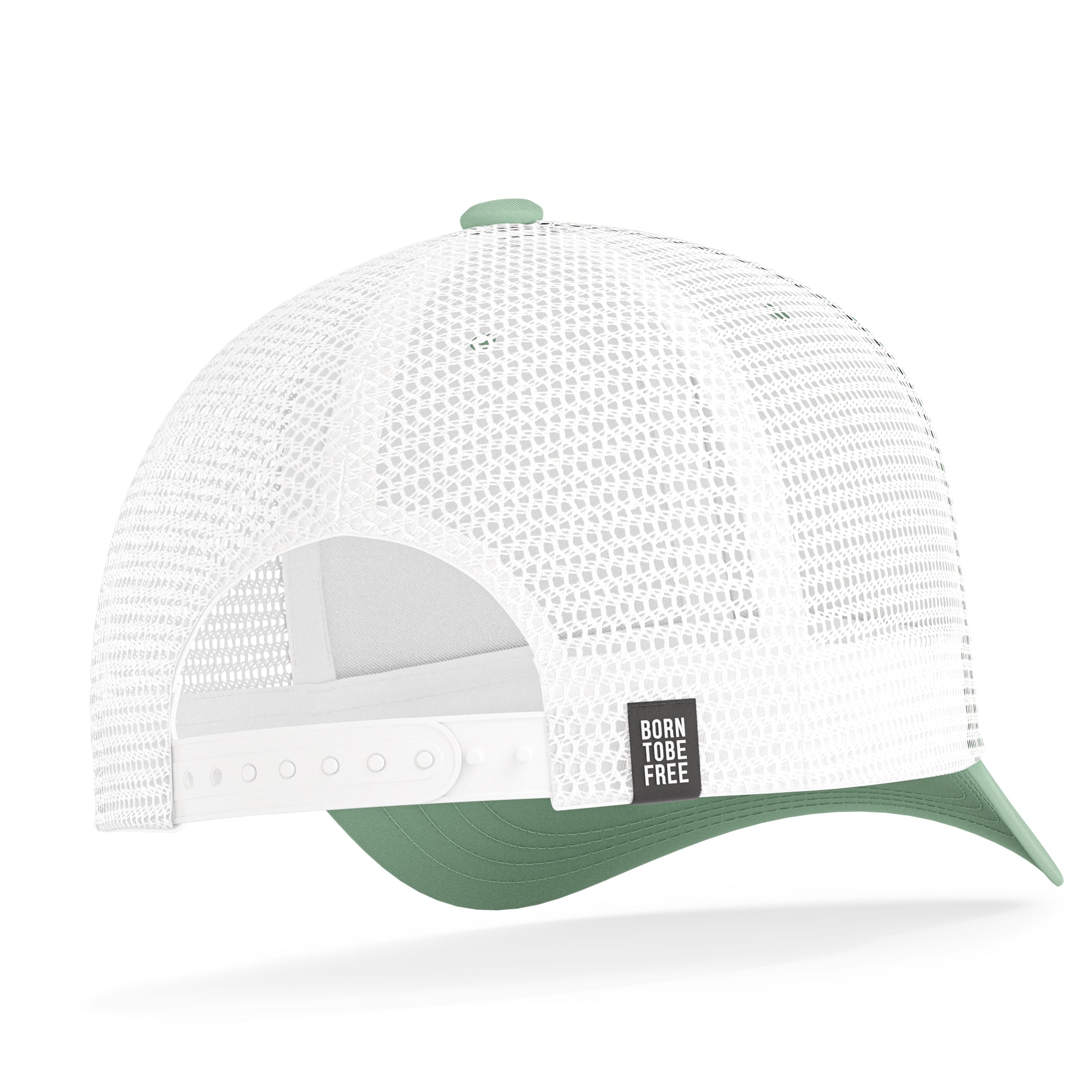
The snapback closure has two plastic strips. One has holes and the other has pegs. Overlap the strips and press until the corresponding pegs snap into place. Start with a comfortable position and move one notch at a time until the cap feels secure.
If you open it so far that the closure comes undone when you move your head, try a wider range. If one position is loose and the next is too tight, a sliding strap may allow a finer adjustment.
To compare closure types, explore the cap collection and look at the photos of the back.

WHEN TRYING IT ON
Three mistakes when choosing a cap
Measuring with the tape too tight
The measurement will come out smaller and may put you at the limit of a cap’s adjustment range. Let the tape rest against your skin without compressing it.
Adjusting the closure to fix rubbing against your ear
If it still rubs when the band fits comfortably, try a different crown depth. Tightening it more could end up leaving a mark on your forehead.
Choosing based only on how it looks from the front
Look at it from the side, too. Check the band’s position, the distance to your ear, and the space for the arms if you wear glasses.
SIZE QUESTIONS
Frequently asked questions about cap fit
What cap size do I need if my head measures 58 cm?
One whose size range includes 58 cm. If the manufacturer uses letter sizes, check the equivalent measurement in centimeters for that model.
Does a one-size cap fit every head?
One size means it comes in a single size. If it has an adjustable closure, its range of adjustment lets it fit a range of sizes. Check that your head circumference falls within that range.
How should a cap fit?
The band should fit snugly without pressing on your forehead. When you look down or turn your head, the cap should stay in place.
How do I know if I need a lower crown?
Try it if the side edge touches your ears even when the band is adjusted properly.
Can I use my hat size to choose a cap?
Use the measurement in centimeters as a starting point. Then check the size chart or range for the specific model and check the crown depth.
What should I do if it fits around my head but keeps moving?
Check where the band rests and whether the crown sits all the way down. Try a different closure position and, if it still moves, compare it with a crown of a different depth.
THE INDIAN FACE
Explore the cap collection
Compare the profiles, brims, and closures of each model with your measurement handy.
EXPLORE CAPS +