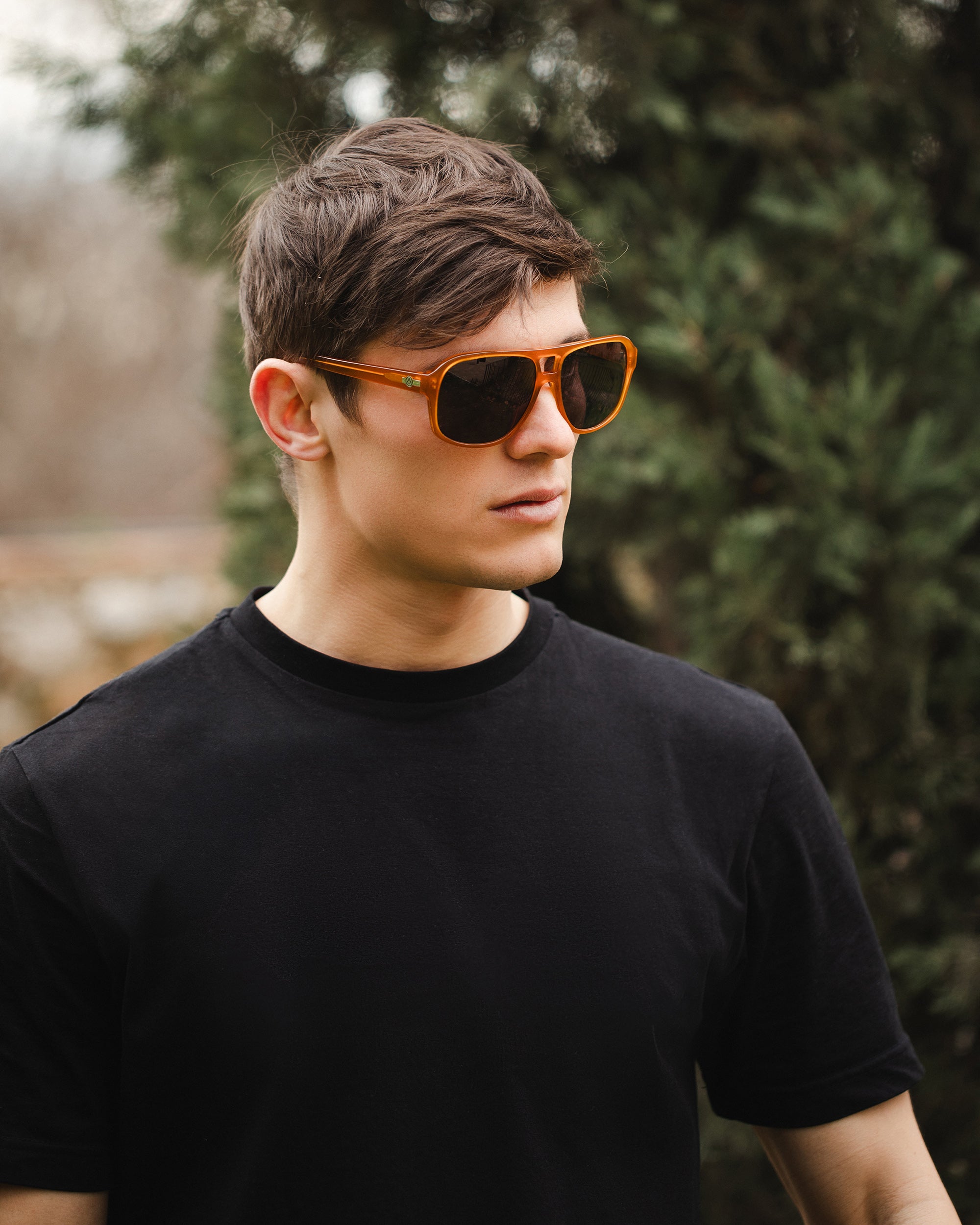
Few sunglasses have a history as recognizable as aviator glasses. Their teardrop shape, thin frame, double bridge, and aesthetic linked to the sky, speed, and adventure have made them one of the most iconic models of all time.
Aviator glasses were not born as a fashion trend. They were born out of necessity. They were designed to protect pilots' eyesight in extreme conditions of light, altitude, and sun exposure. Over time, they moved from flight cabins to the street, cinema, music, and popular culture.
Today they remain a reference in the world of sunglasses. Materials, colors, lenses, and proportions have changed, but their essence remains: a glass created to look far.

What characterizes aviator glasses
Aviator glasses are easy to recognize. Their design usually includes a thin metal frame, double bridge, wide lenses, and a slightly teardrop shape. This silhouette was not an aesthetic whim: it aimed to cover the eye well and protect it from light at altitude.
Their wide shape allowed good coverage, while the lightweight frame made them comfortable for many hours. Originally, functionality was the priority. But precisely that functionality ended up creating a powerful aesthetic.
Aviators convey adventure, security, and freedom. They have something of the road, open sky, and technical history. That’s why they still work decades later.
The military origin of aviator glasses
The origin of aviator glasses dates back to the 1930s, when aviation demanded specific solutions to protect pilots' eyesight. At high altitudes, exposure to sunlight was intense and could cause discomfort, eye strain, and loss of clarity.
The company Bausch & Lomb developed glasses designed for military aviators, with lenses capable of reducing brightness without compromising vision too much. From there came the model that would end up giving rise to one of the most famous shapes in the history of sunglasses.
The interesting thing is that these glasses were not born to look elegant. They were born to solve a real problem. And maybe that’s why their design has aged so well: because the beauty of aviators comes from their utility.

From technical tool to cultural symbol
During World War II, aviator glasses began to gain visibility. Pilots wore them for protection, but images of military personnel and public figures with this type of glasses helped turn them into a symbol.
One of the most memorable moments was the image of General Douglas MacArthur wearing aviator-style sunglasses. That kind of photograph helped associate the model with authority, leadership, and presence.
After the war, aviator glasses began to be marketed to the general public. What had been a technical piece became a fashion accessory. The transition was natural: they had history, functionality, and a shape unlike anything else.
Why they became so popular
Aviator glasses had several advantages. They were unisex, suited many face types, offered good coverage, and conveyed a strong aesthetic without being too extravagant.
They also connected with a very powerful idea: freedom. The imagery of the pilot, the journey, the sky, and speed made these glasses seem much more than an accessory. Wearing aviators was wearing a part of that attitude.
Over time, different brands reinterpreted the design. Green, brown, gray, mirrored lenses appeared, along with gold, silver, black frames, or larger and smaller versions. But the base remained recognizable.

Aviator glasses in film and music
Cinema helped cement the legend. Aviator glasses have appeared in movies, music videos, concerts, and iconic photographs. But if there is one film that brought them back to the mainstream, it was Top Gun.
Tom Cruise, playing Maverick, made aviators an extension of the character: confidence, speed, youth, rebellion, and open sky. The image was so powerful that the model returned to the center of fashion.
Musicians and artists like Elvis, Freddie Mercury, Paul McCartney, David Bowie, and film figures like Steve McQueen and Brad Pitt have also helped keep this aesthetic alive. Each wore them their own way, showing that aviators could adapt to very different styles.

Which faces do aviator glasses flatter
One reason aviator glasses keep working is that they flatter many face types. Their slightly drooping shape and soft structure can balance strong features and add visual length.
On square faces, they help soften the jawline. On oval faces, they usually fit easily. On triangular or heart-shaped faces, they can balance the upper area if the proportion is right. On round faces, they can work if the frame has enough structure and isn’t too small.
As always, the key is proportion. An aviator that’s too large can dominate the face; one that’s too small can lose presence. The glasses should complement, not disguise.
Classic aviator or updated aviator
Today there isn’t just one way to wear aviator glasses. The classic model remains recognizable, with a thin metal frame and teardrop-shaped lenses. But there are also more modern versions: thicker frames, mirrored lenses, bolder colors, matte finishes, or slightly geometric shapes.
If you’re looking for a more elegant style, a classic aviator in gold, silver, or black can work very well. If you want something sportier, mirrored or polarized lenses add a more technical vibe. If you prefer something more urban, a dark frame or a more structured version can feel more current.
The important thing is to choose an aviator that makes sense with your lifestyle. Glasses for driving are not the same as those for the beach, city, or mountains.

Why they remain current
Aviator glasses remain current because they do not depend entirely on a trend. They have history, functionality, and a recognizable shape. They may appear more or less strongly depending on the season, but they never disappear completely.
They also connect with something that still holds value: the idea of adventure. Aviator glasses seem made for driving, traveling, looking far away, and leaving home. They have an aesthetic that combines technique and freedom.
At The Indian Face, we are precisely interested in that union: glasses that are not just fashion, but part of a way of living. If you are looking for models with character, you can discover our collection of sunglasses.
How to style aviator glasses
Aviator glasses are very versatile. They work with a white t-shirt, jeans, leather jacket, open shirt, linen garments, travel clothes, caps, parkas, sweatshirts, or more urban looks.
For a classic style, pair them with neutral colors and simple garments. For a more outdoor vibe, they work very well with earth tones, greens, denim, and comfortable clothing. For a more cinematic look, a light jacket and a metal frame can be enough.
The secret is not to force it. Aviators already have history. Just let them do their job.
Frequently asked questions about aviator glasses
Who invented aviator glasses?
The original design was developed in the 1930s by Bausch & Lomb to protect military pilots' eyesight in high brightness conditions.
Why are they called aviator glasses?
Because they were born as a solution for aviators, especially pilots who needed protection from the sun and intense light during flight.
What face shapes do they flatter?
They usually flatter oval, square, triangular faces, and some round faces, as long as the frame's proportion is appropriate.
Are aviator glasses still in fashion?
Yes. They are a timeless model that keeps coming back because it combines history, functionality, and a very recognizable aesthetic.
Where to buy sunglasses with an adventurous style?
You can find different models with an outdoor spirit in the The Indian Face sunglasses collection.
Conclusion
Aviator glasses were born to protect pilots' eyesight and ended up becoming a cultural icon. Their story combines technology, adventure, cinema, music, and fashion. Few frames have managed to stay so recognizable for so long.
Today they remain a choice with character. Not only for how they look, but for everything they evoke: freedom, travel, altitude, the road, and a far-reaching gaze.