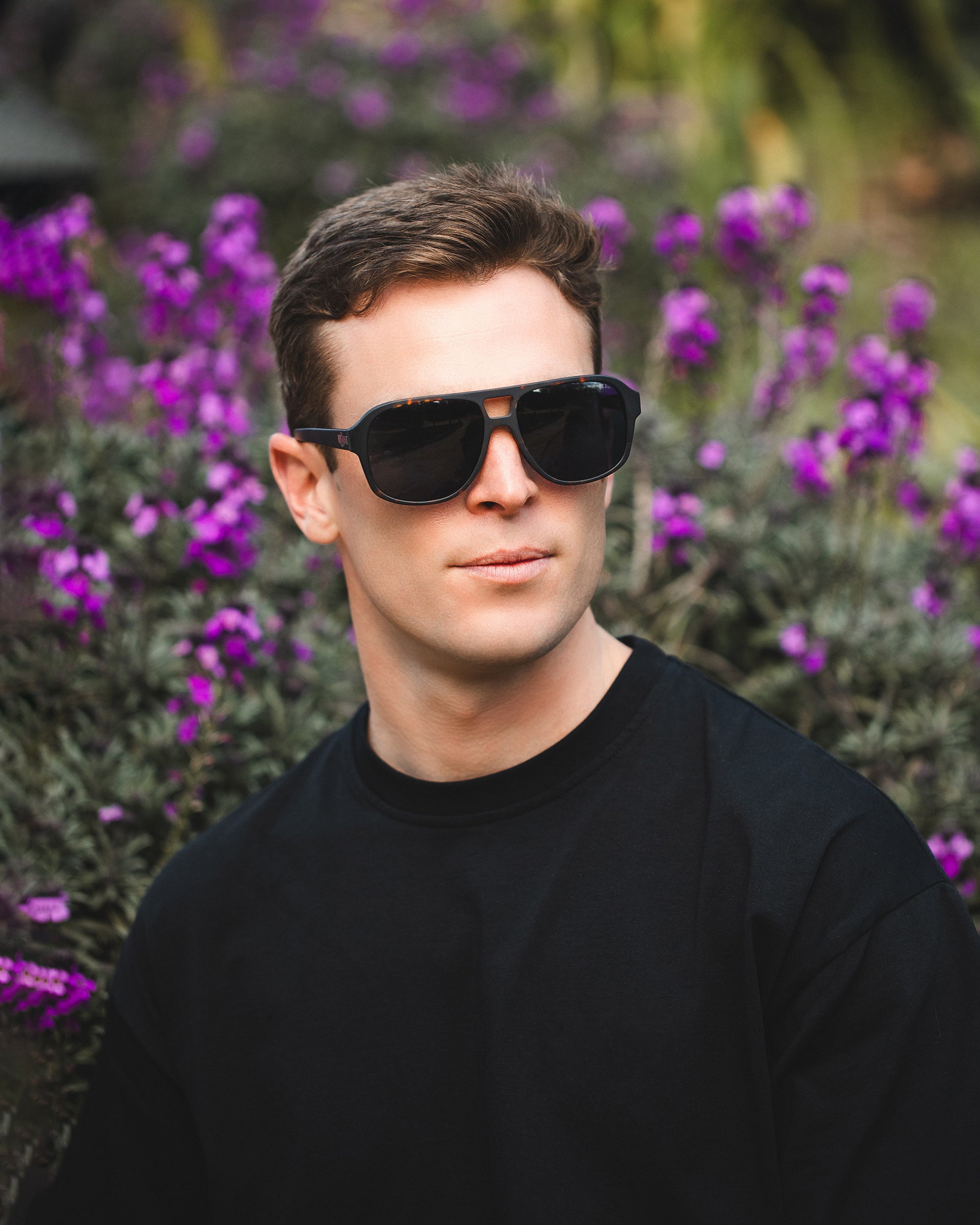
Frontier: the story behind sunglasses born to cross limits
Crossing borders, exploring unknown lands, facing unpredictable nature, and living with your gaze set a little further beyond has always been the task of explorers, mountaineers, travelers, dreamers, and people who refuse to stay where they are.
In this article, we want to tell you the story behind one of our most special sunglasses: the Frontier sunglasses. Their shape, colors, size, and name are no coincidence. Frontier means border. And for us, a border is not just a line that separates two places. It is also an invitation. A point of tension between the known and what is yet to be discovered.
The word frontier has been, for centuries, a motivation to cross it. To go further. To discover what lies on the other side. To unite territories, open paths, and see the world differently.
Our Frontier collection is born as a tribute to all those spirits who once gathered courage to cross invisible lines and transform the way we understand the world.
How we found inspiration to create Frontier
To shape Frontier, we researched stories of men and women who continue to inspire us. People who traveled, wrote, explored, observed, and faced the unknown long before the world was at the reach of a screen.
Today it seems there are no more blank spaces on the map. We can see almost any corner of the planet from home, check routes, observe mountains, seas, deserts, and cities without moving. But adventure does not depend solely on the unknown. Adventure is also a way of seeing.
Places can always be rediscovered. You can always look again with new eyes at a landscape you thought you knew. You can always keep alive the restlessness of those who opened doors before us.
Frontier is born from that idea: the desire to move forward, to look further, and to remember that the spirit of exploration still makes sense even in an apparently discovered world.
Let's travel to the past
Meeting a new world

The voyages of Christopher Columbus to America forever changed the world’s conception. He made four expeditions to a continent unknown to Europe at the time, although his initial intention was to reach the East by a different route.
His theory was wrong, but that mistake opened a new chapter in history. Columbus didn’t find exactly what he was looking for, but he found something that transformed the map, trade, navigation, and the way the West understood itself.
Frontier also embraces that idea: you don’t always reach the intended destination. Sometimes the true discovery happens precisely when the path diverges.
Discovery of a passageway
One of the great names in navigation was Fernando de Magellan, a Portuguese explorer who discovered the so-called “Strait of All Saints,” now known as the Strait of Magellan. That passage connected the Atlantic Ocean with the Pacific and opened a new possibility to sail around America.

Magellan was close to being the first man to complete the circumnavigation of the globe but died during the expedition. It was Juan Sebastián Elcano who completed that feat and returned to Spain after accomplishing one of the greatest maritime achievements in history.
The story of Magellan and Elcano perfectly represents the Frontier spirit: opening a route when no one knows if it exists, moving forward with uncertainty, and leaving a trail others can follow later.
Traveler, spy, and writer
The book Travels of Alí Bey recounts the adventures of Domingo Francisco Jorge Badía y Leblich, better known as Alí Bey. He was a traveler, spy, soldier, and Arabist. A life hard to sum up in a single word.
Among his travels, the journey he made through the Arab world stands out, visiting places like Morocco, Syria, Egypt, and Libya. At a time when those territories were distant and mysterious to much of the West, Alí Bey was able to observe, study, and narrate them from within.

Its story connects with an essential idea of Frontier: traveling is not just moving from one place to another. Traveling is also learning to look, interpret, and understand what at first seems foreign.
Where the Nile is born
John Hanning Speke and Richard Francis Burton form one of the most well-known pairs in the history of exploration. Burton was an anthropologist, linguist, translator, and adventurer. Speke was a soldier and explorer. They both shared an expedition marked by ambition, physical exhaustion, and an increasingly difficult personal relationship.
In 1856 they set out on a journey to discover the sources of the Nile. The outcome was harsh. Illnesses, disagreements, and a rivalry that ended up separating them forever. Speke believed he had discovered the Nile's origin at Lake Victoria and returned to England to present his findings.

Beyond their conflicts, the story of Speke and Burton speaks of an era when exploring involved real risk. There were no complete maps, immediate communications, or certainties. Every step was a decision. Every route, a gamble.
That kind of determination is part of the universe that inspires Frontier: the idea of moving forward even when not everything is clear, accepting discomfort, and understanding that adventure rarely happens under perfect conditions.
We are quite sure that, if they had existed at that time, America, Lake Victoria, or the routes of the Arab world would have been seen differently through a pair of Frontier glasses in the eyes of those explorers.
Let's review the now
The heart of Africa told from within

Writer, journalist, and traveler, Ryszard Kapuscinski was one of the great storytellers of the 20th century. He worked as a correspondent in Africa during the communist era and witnessed numerous conflicts, coups, and decolonization processes up close.
Kapuscinski was not an explorer in the classic sense of opening geographical routes, but he did explore human, political, and cultural territories. His focus was on places where history unfolded with violence, fragility, and contradiction.
Her book Ebony is one of the great works to understand a part of the African continent from a journalistic and literary perspective. It reveals something that deeply connects with Frontier: the need to observe with respect, to approach the world without simplifying it, and to accept that traveling can also be a way of understanding.
It's never too late to travel

Isabella Bird was one of the most important travelers of the 19th century. She dedicated much of her life to exploring, writing, and photographing everything she found along the way. She was the first woman member of the Royal Geographical Society, a huge recognition at a time when traveling alone and documenting the world was not exactly common for a woman.
She made her first great journey at 40 and her last at 72. During that time, she visited America, India, Malaysia, Japan, Tibet, Iran, and other territories that were reflected in her writings.
Isabella Bird shows that adventure does not belong only to a specific age or type of person. Restlessness can appear, grow, and accompany us throughout life. Frontier is also born from that idea: it is never too late to see the world differently.
There are no longer any land boundaries that cannot be overcome
Sir Edmund Hillary, climber and philanthropist, was, along with Tenzing Norgay, the first man to reach the summit of Everest. His name became forever linked to the highest mountain on the planet, but his life was much more than a single peak.

Hillary undertook extraordinary expeditions and also dedicated part of his life to philanthropic projects linked to the Sherpa people. His figure represents a form of adventure that does not end in personal conquest but continues in commitment to the places and people along the way.
Frontier does not see exploration as a mere quest for records. It sees it as an attitude: to advance, learn, respect, and leave something better behind.
The next frontiers are in space
Yuri Gagarin could not be missing from this story. He was the first human to travel to space and see Earth from outside. In 1961, aboard the Vostok 1 spacecraft, he saw our planet from a distance that until then had only belonged to imagination.

With Gagarin, the frontier ceased to be solely land or sea. Humans began to look beyond the planet. Exploration changed scale, but not its essence. It was still about the same thing: crossing a boundary that seemed impossible.
Frontier also looks toward that kind of frontier. Not just the one that separates countries or continents, but the one that separates what we believe is possible from what we haven’t yet tried.
Frontier is exploration, design, and quality
Besides having a design that combines retro aesthetics, vintage inspiration, and an easy-to-wear shape, the Frontier glasses are made to accompany outdoor life. They’re not just a nod to the past. They’re a current piece for those who still feel the call to move, travel, and discover.
Their design blends past and present. They have something of classic explorer glasses, something of the road, something of the mountains, and something of the city. It’s a frame with character, but not over the top. Glasses that can accompany a trip, a getaway, a day at the beach, a hike, or any afternoon outdoors.
The Frontier feature polarized lenses, designed to reduce sun glare and reflections, offering a more comfortable view of your surroundings. They also incorporate TAC FULL HD technology, aimed at providing sharper visibility and a high-definition visual experience.
Because good sunglasses shouldn’t just complete a look. They should help you see better. Protect you. Make you feel comfortable. Be ready to go out.
At The Indian Face we don’t leave the past behind. We use it as inspiration. We combine the legacy of those who came before us with our current references to create designs that speak of who we are and how we want to live.

Conclusion: crossing the frontier begins with the gaze
Frontier is our way of paying tribute to those who lived seeking new paths. Explorers, travelers, journalists, mountaineers, sailors, and people who understood that the world is not discovered from absolute comfort, but from curiosity.
Today we may not need to cross oceans without a map or traverse unknown territories to feel like explorers. But we can keep that attitude: look more closely, move more, go out more, travel better, and keep the curiosity alive.
Frontier glasses are born from that inspiration. From the frontier as a symbol. From the journey as a way of life. From the gaze as the first step.
Because before crossing any boundary, there is always something that changes first: the way you choose to look.